Brazil’s Landless Workers’ Movement (MST) is Latin America’s largest social movement, having struggled for decades for a people’s agrarian reform and social justice in Brazil. Since its foundation in the early 1980s, the MST has combined land occupations, cooperative work, political education, and internationalism to challenge the country’s highly concentrated latifundia system and resist the expansion of agribusiness. The movement has developed a model of collective struggle rooted in solidarity and mass mobilisation, organising hundreds of thousands of families in rural Brazil. When MST occupies a tract of underutilised or idle land, it first establishes an acampamento (encampment). An acampamento is a direct-action method of pressuring the government to redistribute land in keeping with Brazil’s agrarian reform laws. During this period, the movement organises political education, collective work, and self-governance. If the struggle succeeds, the acampamento will transition into an assentamento (settlement), now recognised and legalised by the state, and therefore more stable. Like acampamentos, assentamentos are collective projects, even if the families in them maintain individual parcels. In an assentamento, the land cannot be bought or sold. It technically belongs to the state but is managed by the collective or by what could be called the commune. Assentamentos are also self-governed, administer much of their own justice, and self-manage their educational processes. In short, both acampamentos and assentamentos express a high degree of communal control over their production and day-to-day life. Beyond the struggle for land, the MST works to confront broader capitalist dynamics by embracing agroecology, cooperative production, and political education. All these are elements of what the movement calls a “people’s agrarian reform.” The idea of the “people’s agrarian reform” is that, in a world where financial capital and multinational corporations dominate agriculture, it is not enough to secure land for the landless. One must also develop an alternative model of production and life, embodying socialist and ecological principles. In this interview, João Pedro Stedile, a key spokesperson and founder of the MST, discusses the movement’s emphasis on collective struggle and solidarity, the challenges of organising cooperative production, and the evolution of the MST’s goals in response to the changing capitalist economy. He also examines the MST’s strategy of building alliances between the rural and urban working class and its engagement with international struggles, particularly with the communal movement in Venezuela. At a time when capitalism is deepening both inequalities and ecological destruction, the MST’s experiences and proposals offer valuable insights into the building of a socialist future —C. G. & C. P. M.
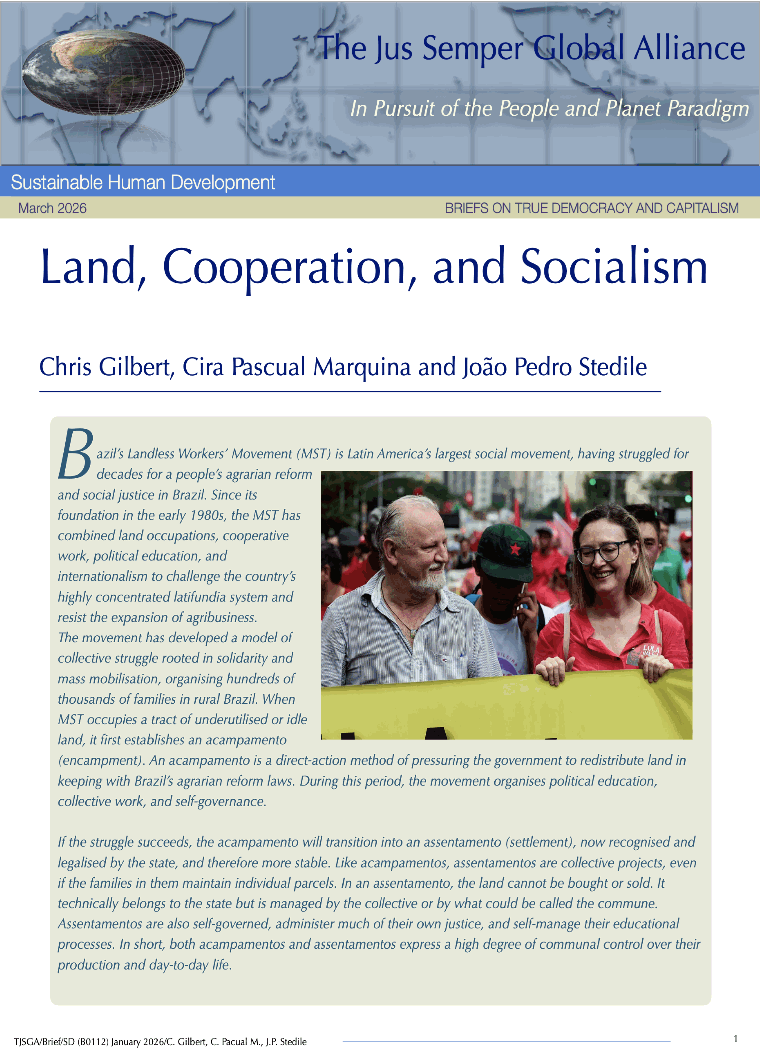
For a full review of this essay, click here or on the picture to download the pdf file. |

- © The Jus Semper Global Alliance




| Home |  | Resources | | Economic Data | | Land, Cooperation, and Socialism |

