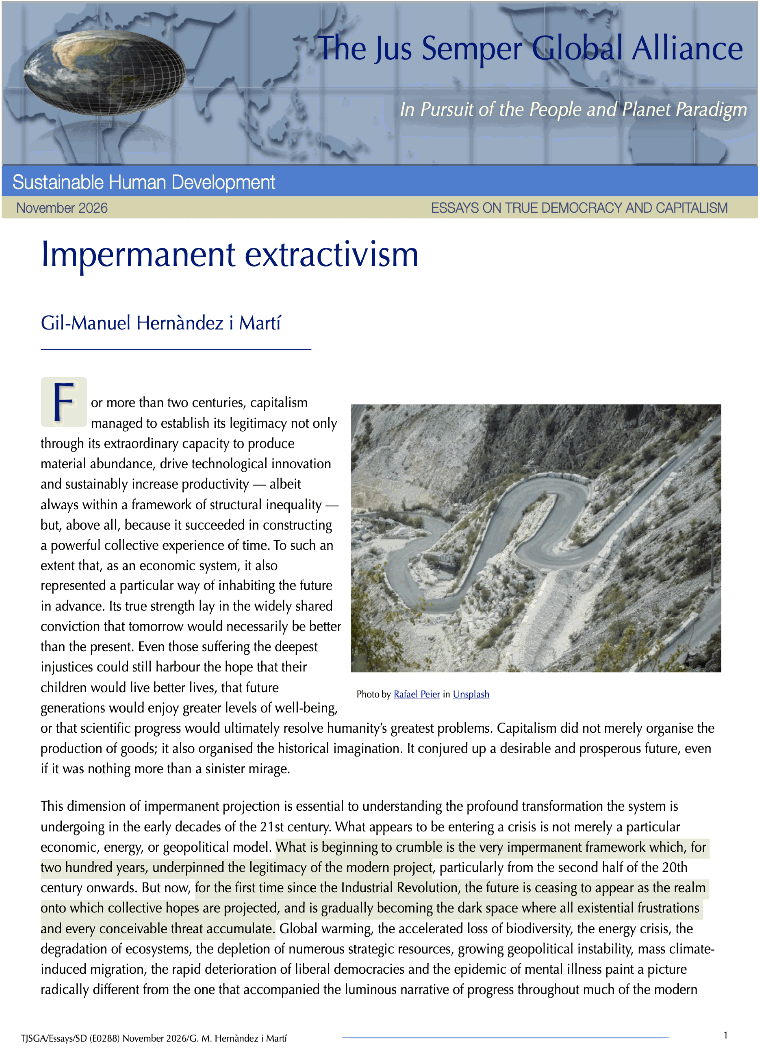
Gil Manuel Hernández i Martí For more than two centuries, capitalism managed to establish its legitimacy not only through its extraordinary capacity to produce material abundance, drive technological innovation and sustainably increase productivity — albeit always within a framework of structural inequality — but, above all, because it succeeded in constructing a powerful collective experience of time. To such an extent that, as an economic system, it also represented a particular way of inhabiting the future in advance. Its true strength lay in the widely shared conviction that tomorrow would necessarily be better than the present. Even those suffering the deepest injustices could still harbour the hope that their children would live better lives, that future generations would enjoy greater levels of well-being, or that scientific progress would ultimately resolve humanity’s greatest problems. Capitalism did not merely organise the production of goods; it also organised the historical imagination. It conjured up a desirable and prosperous future, even if it was nothing more than a sinister mirage. This dimension of impermanent projection is essential to understanding the profound transformation the system is undergoing in the early decades of the 21st century. What appears to be entering a crisis is not merely a particular economic, energy, or geopolitical model. What is beginning to crumble is the very impermanent framework which, for two hundred years, underpinned the legitimacy of the modern project, particularly from the second half of the 20th century onwards. But now, for the first time since the Industrial Revolution, the future is ceasing to appear as the realm onto which collective hopes are projected, and is gradually becoming the dark space where all existential frustrations and every conceivable threat accumulate.
For a full read of this essay, click here or on the picture to download the pdf file.
|




- © The Jus Semper Global Alliance
| Home |  | Resources | | Economic Data | | Impermanent Extractivism |


